
One is speeding up checkout, the other is eliminating it—and the economics suggest there’s only one direction this goes
From the Craig Bushon Show Media Team
Costco says your next checkout could take under 10 seconds.
On the surface, that sounds like innovation.
But when you step back, this isn’t really about speed. It’s about pressure.
Because while Costco is trying to make checkout faster, Sam’s Club is already trying to eliminate checkout entirely.
That’s a completely different direction.

Costco is improving what already exists. You still walk up to a register, scan your items, complete a transaction, and show your receipt on the way out. It’s just happening faster.
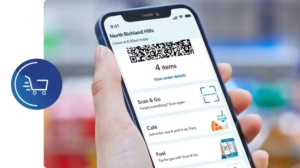
Sam’s Club flipped that model. You scan items while you shop, pay in the app, and walk out. Their system verifies everything automatically at the exit. No lines. No register. No traditional checkout at all.
This isn’t really a technology story. It’s a labor story.
Costco still relies on cashiers, assistants, and employees checking receipts at the door. That’s a significant portion of labor tied directly to completing a sale.
Sam’s Club removes much of that. Fewer employees are needed to process the same number of customers—and that directly translates into fewer jobs tied to the front end of the store.
And this isn’t a small number.
Across Costco and Sam’s Club alone, there are roughly 300,000 to 350,000 U.S. employees. Of that, an estimated 15% to 25% are tied to front-end checkout and exit roles—cashiers, assistants, and receipt checkers.
That means approximately 40,000 to 80,000 roles are directly exposed to this shift.
Not all at once. Not overnight.
But over time.
And that’s just the warehouse club segment.
If this model proves out and spreads into grocery stores, big-box retailers, and other large-scale retail formats, the impact expands significantly. Cashier roles across the U.S. retail economy number in the millions. What’s happening here is not isolated—it’s an early signal of a much broader shift.
And the truth is—this isn’t theoretical anymore.
It’s already happening right in front of people.
Walk into The Home Depot or Lowe’s and you’ll see rows of self-checkout replacing traditional lanes.
Go into fast food and the same pattern shows up. Chains like McDonald’s and Wendy’s have rolled out kiosks, mobile ordering, and app-based payment systems that reduce the need for front-counter staff.
Different industries.
Same model.
Reduce labor at the transaction point. Increase speed. Improve throughput.
And we’re already seeing early signs of that shift in the data.
Retail layoffs surged in 2025. Companies announced roughly 93,000 job cuts—a sharp increase year over year. Across the broader economy, layoffs exceeded 1 million.
But here’s the key detail most people miss.
The real shift isn’t just happening through layoffs.
It’s happening through slower hiring, reduced hours, and natural attrition.
Which means this transformation can accelerate without ever looking like a single disruptive event.
And many analysts believe it already is.
Self-checkout now dominates a large share of grocery lanes. App-based systems like those used by Sam’s Club are expanding rapidly. AI-verified exits are scaling. And early “walk-out” systems from Amazon are moving beyond pilot phases.
If adoption continues at this pace, hundreds of thousands of front-end retail roles could face meaningful pressure well before long-term projections suggest—potentially concentrating much of this transition into the next five to seven years.
Retail runs on tight margins. When one company finds a way to reduce labor, move customers faster, and handle more volume at the same time, that becomes a measurable advantage.
Sam’s Club isn’t just making things easier. They are lowering their cost per transaction.
Over time, that gives them more flexibility to adjust pricing, reinvest into the business, and scale faster.
But here’s the question most people aren’t asking.
Have we actually seen prices come down in a meaningful way at companies that have already adopted these technologies?
Look across retail.
At The Home Depot and Lowe’s, self-checkout has expanded significantly.
In fast food, companies like McDonald’s and Wendy’s have rolled out kiosks, mobile ordering, and app-based systems.
And yet, prices haven’t meaningfully declined.
In many cases, they’ve increased.
That tells you something important about how this system works.
The primary benefit of these efficiency gains is not being passed directly to the consumer.
It’s being absorbed into margins, capital investment, and ultimately shareholder returns.

That doesn’t make it wrong.
It makes it predictable.
Because businesses don’t adopt technology to lower prices first.
They adopt it to lower costs.
And once costs come down, the decision becomes strategic—compete on price, or expand profitability.
Most choose profitability, at least initially.
Which means the consumer gets convenience.
The company gets efficiency.
And the labor that used to sit in the middle of that transaction slowly disappears.
But this raises a bigger question.
Not about whether capitalism works—but how it’s being applied.
Because what we’re seeing here isn’t a failure of the system.
It’s the system doing exactly what it’s designed to do.
Reduce costs.
Increase efficiency.
Maximize returns.
And in this case, that means removing as much labor as possible from the transaction.
Some people might look at that and call it a flaw in capitalism.
But that’s not quite accurate.
The system itself isn’t broken.
What it exposes is how decisions are being made inside the system.
Because once those efficiency gains are created, companies have a choice.
They can pass savings to consumers, reinvest into workers, or retain those gains as profit.
And right now, the dominant trend is clear.
Those gains are moving up the chain—toward margins, capital investment, and shareholder returns.
Not down toward lower prices or expanded labor.
So this isn’t a “Robin Hood” effect—redistributing value outward.
It’s the opposite.
Value is being concentrated upward through efficiency.
And that’s not an automatic outcome of capitalism.
That’s a decision.
A decision made by leadership, boards, and investors about how to allocate the benefits of innovation.
Now here’s where this becomes real for the everyday shopper.
At first, it just feels like convenience. Less time in line. Faster trips.
But what’s actually changing is expectation.

Once people get used to walking in, grabbing what they need, and walking out, anything slower starts to feel broken.
Now here’s where this gets even more important.
What Sam’s Club is doing right now is not the end state. It’s the bridge.
The next generational leap in this technology is removing the need to scan anything at all.
You won’t pull out your phone.
You won’t scan items.
You won’t stop at a register.
You’ll simply walk in, pick what you want, and walk out—and the system handles the rest.
That’s where this is going.
And when that model becomes reliable at scale, even “Scan & Go” will start to feel like a temporary step.
Because from a pure efficiency standpoint, the best checkout is no checkout at all.
But there’s a tradeoff.
The more frictionless the experience becomes, the more data the system has to collect.
What you pick up.
What you put back.
How long you stand there.
All of it becomes part of the transaction.
This isn’t just about reducing jobs.
It’s about reallocating capital.
Money that once went to wages now shifts toward technology, infrastructure, and data systems.
Costco speeding up checkout is not the final destination.
Sam’s Club removing checkout is the next phase.
Invisible checkout is the endgame.
Bottom line
Costco is trying to make checkout faster.
Sam’s Club is trying to make checkout irrelevant.
And the next wave of technology is trying to make checkout invisible.
The evolution is clear.
Faster checkout was step one.
No checkout is step two.
Invisible checkout is step three.
And alongside that evolution, fewer workers are needed at the front end of retail.
From the Craig Bushon Show Media Team:
What you’re watching is not just a retail evolution—it’s a structural shift in how value is created, distributed, and sustained in the economy.
And this isn’t just about profits or jobs lost.
This transition will ultimately be defined by the people making decisions at the top.
How this technology is implemented.
How fast it’s rolled out.
And most importantly—what is done with the human capital that built these companies in the first place.
Because there’s a bigger economic reality sitting underneath all of this.
As more front-end roles are reduced, even gradually, you’re not just lowering costs—you’re also reducing the number of people with income to participate in the very system these businesses depend on.
Consumers are not separate from the system.
They are the system.

And when income is reduced at scale, spending follows.
Which means the same companies driving efficiency gains may eventually feel the effects on the demand side of the equation.
That’s the feedback loop very few are talking about.
So the real question isn’t just how much efficiency we can create.
It’s whether the system can sustain itself if too many people are removed from the income side of the equation.
Because if we get this wrong, it won’t matter how much profit companies think they’re gaining in the short term.
It becomes self-defeating.
The very efficiency driving profits higher will simultaneously reduce the number of customers able to support those profits.
And when that happens, those gains don’t compound.
They reverse.
Disclaimer: This opinion piece is for informational and commentary purposes only. It reflects analysis based on publicly available information and observed retail trends. It is not intended as financial, investment, or employment advice, and actual business strategies or outcomes may vary.


