
The Merchant Drone Carrier Problem: How China Is Quietly Redefining Naval Power By The Craig Bushon Show Media Team
We don’t just follow the headlines. We read between the lines to get to the bottom line of what’s really going on.
When images surfaced of a Chinese cargo ship apparently modified to launch advanced combat drones using a modular electromagnetic catapult system, the initial reaction online ranged from disbelief to dismissal. A gimmick. A mock-up. A science experiment that would never work at sea.
That reaction misses the larger point.
Because this is not about one ship. It is about a doctrine. And more importantly, it is about a pattern that is now impossible to ignore.
China is systematically erasing the traditional boundaries between civilian and military maritime power, not by building more aircraft carriers, but by turning ordinary-looking platforms into launch nodes for unmanned warfare.
The cargo ship is simply the most visible and unsettling example.


Open-source imagery and reporting indicate the vessel has been modified with containerized systems and what appears to be a truck-mounted electromagnetic launch track capable of accelerating fixed-wing drones into flight. Recent updates show rapid reconfiguration at the Hudong-Zhonghua shipyard, with the modular catapult installed on deck alongside remaining containerized weapon elements. Even if limited by sea state or endurance, such a configuration would still allow China to put unmanned aircraft into the air from hulls that look civilian until the moment they are not.
That ambiguity is not a bug. It is the feature.
A merchant silhouette complicates rules of engagement, compresses decision timelines, and forces adversaries to hesitate. In modern warfare, hesitation is often more valuable than firepower.
This concept fits cleanly into what military planners describe as a quantity-and-ambiguity strategy: expand the number of launch points, reduce their individual cost, and increase uncertainty for the opponent. The objective is not to win a duel, but to overwhelm the decision-making process itself.
What makes this development more than an isolated experiment is what is happening in parallel within China’s purpose-built naval fleet.
At the center of that evolution is the Type 076 Amphibious Assault Ship, a vessel that signals where this doctrine is ultimately heading.
The Type 076, NATO reporting name Yulan-class, is not a traditional amphibious assault ship. It is a hybrid platform, combining the troop transport and landing craft functions of a landing helicopter assault ship with the aviation features of a light aircraft carrier. Unlike Western equivalents, however, its aviation model is not built around manned jets.
It is built around drones.



The lead ship, Sichuan, was launched in December 2024. As of early 2026, it has completed initial sea trials and is progressing toward expected commissioning later this year. With a full-load displacement exceeding 40,000 tons, it is comparable in size to U.S. America-class amphibious ships. The difference is philosophical as much as technical.
The Type 076 is the first amphibious assault ship in the world equipped with an electromagnetic aircraft launch system and arresting gear. That CATOBAR configuration allows it to launch and recover fixed-wing unmanned aircraft, something Western LHAs cannot do without relying on short takeoff and vertical landing jets.
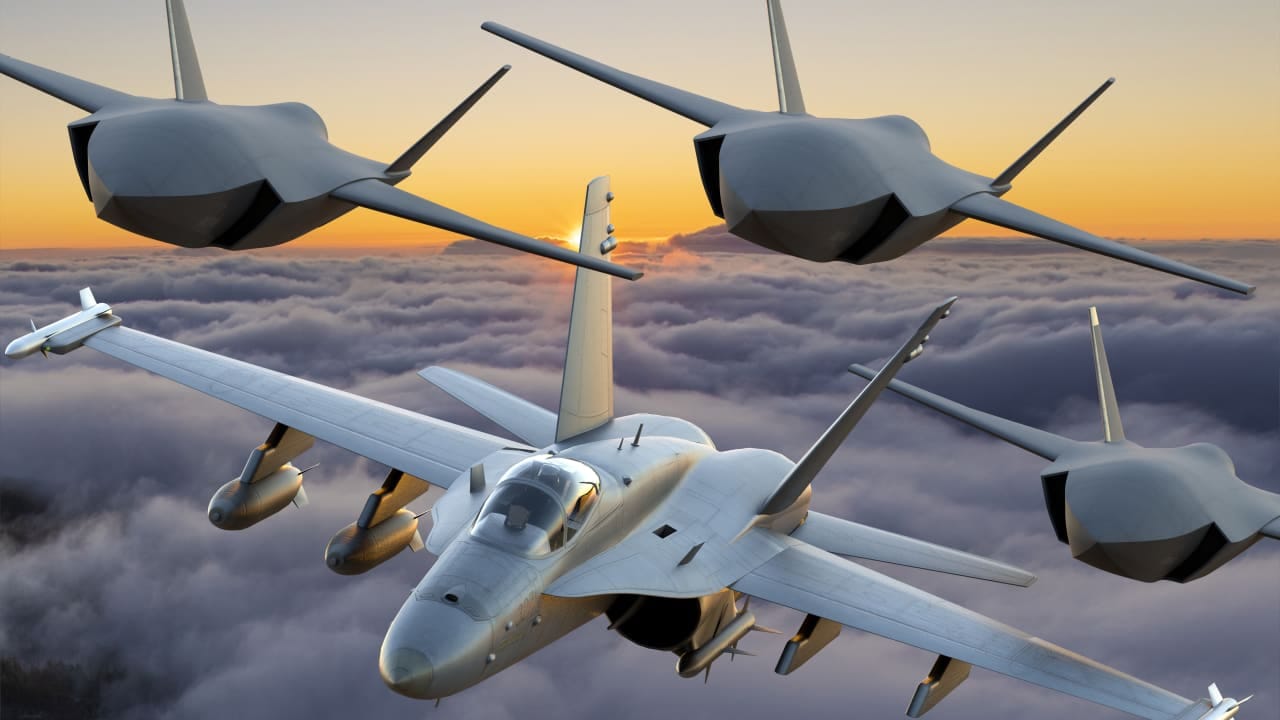
This is not a theoretical capability. The ship’s design—a full-length flight deck, twin-island superstructure, expansive hangar volume, and integrated electric propulsion optimized for high power loads—exists specifically to support unmanned aviation. Recent dockside imagery shows low-observable combat drones, including platforms resembling loyal-wingman designs, staged for potential deck trials aboard Sichuan.
Expected aircraft include stealthy combat drones such as the GJ-11 Sharp Sword, a flying-wing unmanned combat aerial vehicle optimized for strike and intelligence missions, high-altitude reconnaissance platforms like the WZ-7 Soaring Dragon, and collaborative combat aircraft designed to operate alongside manned assets. In practical terms, this means dozens of UAVs capable of persistent surveillance, electronic warfare, decoy operations, and precision strike.

Why the GJ-11 Scares Planners What unsettles military planners about the GJ-11 is not any single advertised capability, but the way it collapses multiple long-standing assumptions about airpower. It combines stealth, range, autonomy, and internal strike payloads into a platform that is cheaper, more expendable, and more scalable than manned aircraft—yet still capable of penetrating defended airspace. That breaks the traditional cost-exchange logic on which air defense planning relies. Interceptors and high-end surface-to-air missiles are expensive; losing them to attritable stealth drones is strategically inefficient. Even more concerning, the GJ-11 is designed to operate cooperatively—with manned fighters, electronic warfare aircraft, or other drones—creating layered dilemmas where defenders must decide what to shoot first, often with incomplete information. When launched from mobile platforms such as drone-capable amphibious ships or converted civilian hulls, the threat becomes even harder to localize, track, and preempt. In short, the GJ-11 does not just threaten targets—it threatens the defender’s ability to confidently classify, prioritize, and respond under time pressure. That erosion of decision certainty is precisely what modern air and missile defense architectures are least prepared to handle.
The Type 076 does not replace China’s aircraft carriers. It complements them by doing something carriers are poorly optimized for: mass, persistence, and attrition-tolerant air operations in contested littorals.
And this is where the cargo ship conversion snaps into focus.
What the Type 076 represents at the high end—a purpose-built drone-centric warship—the modified cargo vessel represents at the low end: a rapidly scalable auxiliary option. One is refined and integrated. The other is improvised and modular. Together, they reveal a coherent strategy.
China is building a layered maritime force in which high-end carriers provide prestige and air superiority, hybrid ships like the Type 076 deliver sustained unmanned pressure, and converted civilian hulls expand launch capacity while complicating targeting and escalation decisions.
In a Taiwan or South China Sea scenario, this matters enormously.
Drone-launch-capable merchant ships positioned near shipping lanes or ports could provide intelligence collection, decoy saturation, or electronic warfare support while blending into commercial traffic. They could feed targeting data to missile forces without ever presenting as traditional combatants. Even if they are launch-only platforms with no recovery capability, they still force adversaries to spend time, sensors, and interceptors dealing with them.
Critically, they also raise the risk of miscalculation. When civilian hulls are deliberately weaponized, every identification decision becomes fraught. The line between lawful military target and protected civilian object grows thinner, and escalation becomes harder to control.
To be clear, serious questions remain. Launching fixed-wing aircraft from a rolling civilian deck is not trivial. Electromagnetic systems are sensitive to alignment and power stability. Drone recovery, sustainment, and command-and-control resilience in a high-end electronic warfare environment are not guaranteed.
But none of those questions negate the strategic intent.
The intent is to stretch adversary defenses, multiply uncertainty, and leverage civilian infrastructure as latent military mass. That is military-civil fusion in practice, not theory.
How America Is Responding: Not Mirroring, But Out-Innovating The good news is that the United States is not sitting idle. Washington’s answer isn’t to copy China’s dedicated drone carriers or merchant conversions—that would fall into the very quantity trap Beijing is setting. Instead, the U.S. Navy is integrating unmanned systems into its unmatched fleet of 11 nuclear supercarriers while accelerating programs for mass-produced, attritable drones.

Key efforts include the MQ-25 Stingray, a carrier-based refueling drone already testing on decks that will extend the range of manned fighters deep into contested areas.
The Collaborative Combat Aircraft (CCA) program is developing armed “loyal wingman” drones to fly alongside F-35s and future fighters, providing the same mass and persistence China seeks—but with superior manned-unmanned teaming.

And the Pentagon’s Replicator initiative is pouring billions into thousands of low-cost autonomous systems to overwhelm numerical advantages without matching them ship-for-ship.


This approach leverages America’s strengths: technological edge, global alliances, and the survivability of large-deck carriers far from shore.
Policy Takeaway: Denying the Advantage of Ambiguity The appropriate U.S. response is not to chase these platforms ship-for-ship or drone-for-drone. That would play directly into the cost-exchange trap this doctrine is designed to create. Instead, the priority must be denying scale and denying ambiguity.
That begins with earlier detection—treating merchant militarization as an intelligence problem defined by conversion indicators rather than hull identity. It requires updated rules of engagement that remove hesitation when civilian-appearing vessels are used for military effect. It favors electronic warfare, cyber disruption, and network attack over immediate kinetic escalation. It demands layered, cost-effective defenses that do not burn million-dollar interceptors on expendable drones. And it extends beyond the battlespace into insurance markets, port access, export controls, and regulatory pressure on the commercial ecosystems that enable military-civil fusion.
Bottom line, the converted cargo ship is not a gimmick, and the Type 076 is not just another amphibious vessel. Together with platforms like the GJ-11, they signal a shift toward a form of warfare that prioritizes ambiguity over elegance and persistence over prestige.
The next major maritime conflict will not be decided solely by aircraft carriers and destroyers. It will be shaped by drones, logistics, civilian infrastructure, and how quickly leaders can decide what they are really looking at before it is too late.
Because on this show, we don’t just follow the headlines… we read between the lines to get to the bottom line of what’s really going on.
Editorial and disclosure notice: This op-ed represents analysis and opinion based on publicly available reporting, imagery, and open-source defense analysis. Technical assessments are subject to revision as additional verified information becomes available. No claims herein allege unlawful conduct by any private commercial entity.


